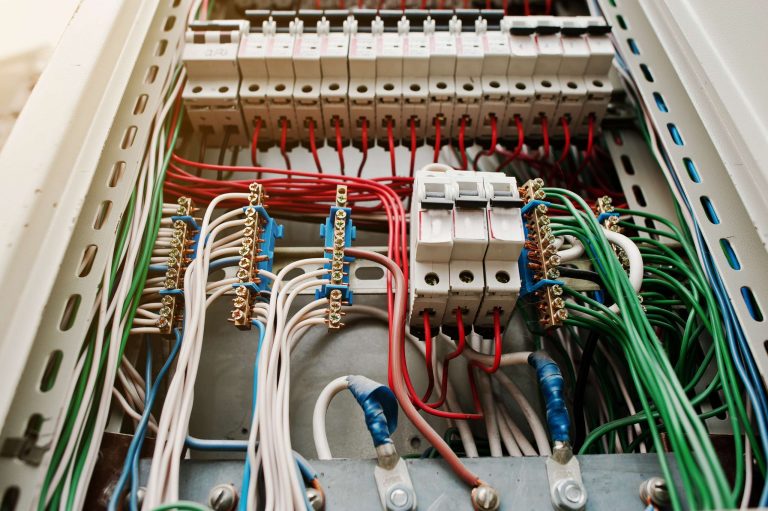
Those colored wires aren’t just for show; they’re a language to keep you from killing yourself. If you learn this language first, it eliminates a lot of the guesswork that makes working with electricity seem so daunting. A standard house current cable has colored wires for the hot, neutral, and ground conductors, and hooking them up wrong can shock you, fry a device, or start a fire. Take some time just to look at and identify the wires within a cable, after you’ve stripped the insulation away. Point at the wire and say what it does. It will help you commit it to memory, and make you more confident when you actually have to hook something up.
For practice, take a small section of cord, mark the wire for black (hot), black (return), white, copper, etc. Then take the markers off and try to tell which is which. Then draw a small circuit, and identify which colored wire the line on the paper corresponds to in the cord. Repeat as needed. It only takes about 15 minutes of going through that and telling the difference for your brain to think of color as part of the data and not just background noise. If you get confused, go back to the drawing and follow where each wire leads as electricity flows from supply to load.
Many folks make the mistake of thinking that all wire colors are standardized, and that is simply not the case. I have run into many situations where the wiring is not only not standard, but not even color-matched with other wiring of the same type. In these cases, depending on the color can get you killed. Your best bet is to test for the proper function using a multimeter, and make sure that you pay close attention to the overall wiring in the circuit. If it doesn’t appear to make sense, then don’t make a guess. Learning to have a healthy dose of skepticism when things don’t appear right is one of the best safety tools you can develop.
During your practice, hook up a simple device, and out loud explain what you are connecting: live to terminal, neutral to return path, ground to protective point. When you vocalize this, it helps clarify it and you will quickly find the missing piece. If the device does not work when you test it, go back through your logic and step by step backtrack the logic. Usually it becomes clear that you have an interrupted circuit instead of a puzzled failure.
In this case, regularity beats urgency. Ten to fifteen minutes a day spent practicing color coding, reading diagrams, and proper care means eventually you don’t even need to think about it anymore. You’ll do it out of habit before any job, and you’ll be able to focus on other things like the layout, ease of installation, and quality of the work.